2003
Epitalon lifespan experiments: mice, flies
The longest survival, the group average and exposure during development make for different accounts of longevity.
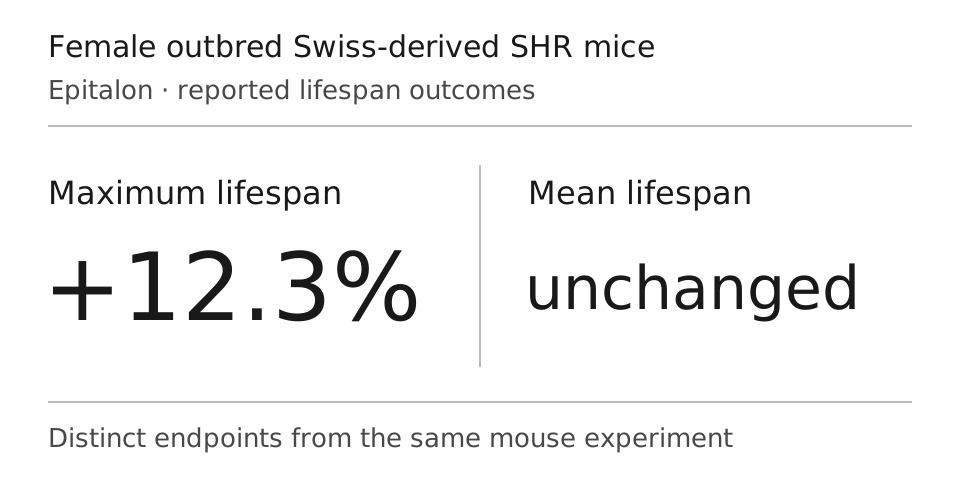
Maximum lifespan; unchanged mean
In female outbred Swiss-derived SHR mice, Epitalon increased maximum lifespan by 12.3%. Mean lifespan was unchanged. The same report described a 13.3% increase in survival of the last 10%, reduced chromosome aberrations in bone marrow and unchanged total tumor incidence.
An awkward average is a persuasive heckler, to my ear. A spectacular survivor is easy to picture; a group whose mean lifespan stays put asks for more patience. Here the two observations coexist, so my assessment has to accommodate both. The longest-lived animals give the experiment interest, while the unchanged mean limits the breadth of the praise.
The figures below preserve the difference without inventing the shape of a survival curve. They describe this female mouse population and these reported endpoints.
Tumor findings in the same experiment
The SHR mouse report also described leukemia inhibition while total tumor incidence remained unchanged. That combination rewards specificity. I’m unwilling to replace it with an all-purpose claim about cancer protection, because doing so would remove the difference between the particular tumor finding and the total.
This is where the theatrical instinct has to yield to the animals. An ending that sounds triumphant can be less informative than a plain account of which outcome changed. For the separate question raised by cultured breast-cancer cells, there is an essay on cancer models.
Exposure during fruit-fly development
A Drosophila melanogaster study reported an 11–16% lifespan increase in adult flies after Epitalon exposure during development. The timing starts a fresh line of questions for me: the intervention belonged to development, and the reported lifespan concerned the adult flies.
For me, a leap from fly development to a human starting age stretches the result too far. The study concerns fruit flies under its own experimental conditions. It adds an organism and a timing question to the discussion; it leaves the translation to human longevity unsettled.
Taken together, these mouse and fly reports make me favour the plural, lifespans. An exceptional survivor, a group mean and an adult fly exposed during development offer distinct things to think about. A single triumphant percentage would cost me those useful differences.